



- 04 Apr 2023
- Book
Two Centuries of Business Leaders Who Took a Stand on Social Issues
Executives going back to George Cadbury and J. N. Tata have been trying to improve life for their workers and communities, according to the book Deeply Responsible Business: A Global History of Values-Driven Leadership by Geoffrey Jones. He highlights three practices that deeply responsible companies share.
- 17 Jan 2023
- Cold Call Podcast
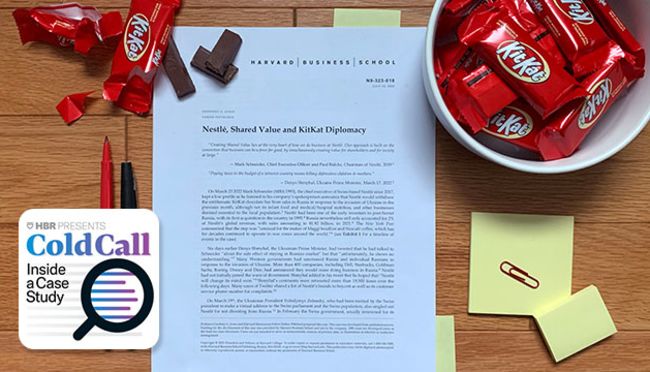
Nestlé’s KitKat Diplomacy: Neutrality vs. Shared Value
In February 2022, Russia invaded Ukraine, and multinational companies began pulling out of Russia, in response. At Switzerland-based Nestlé, chief executive Mark Schneider had a difficult decision to make. Nestlé had a long tradition of neutrality that enabled it to operate in countries regardless of their political systems and human rights policies. But more recently the company had embraced Michael Porter’s “shared value” paradigm, which argues that companies have a responsibility to improve the business community and the health of their communities. What should Schneider do? Professor Geoffrey Jones discusses the viability of the shared value concept and the social responsibility of transnational corporations today in the case, “Nestlé, Shared Value and Kit Kat Diplomacy.”

- 31 May 2022
- Cold Call Podcast
Corruption: New Insights for Fighting an Age-Old Business Problem
Corruption is as old as humanity, with cases documented as far back as the Egyptian dynasties. While the World Bank estimates that international bribery exceeds $1.5 trillion annually, the larger and more subtle effects of corruption on economies and populations is incalculable. Harvard Business School professors Geoff Jones and Tarun Khanna explore how corruption uniquely affects business in emerging markets, and why it should be addressed by the public and private sectors in their case, “Corruption and Business in Emerging Markets,” and companion video interviews with more than 100 iconic entrepreneurs in emerging markets.

- 29 Mar 2022
- Book
5 Qualities That Help Companies Thrive for Decades—Even Centuries
What makes a business resilient, agile, and enduring? Geoffrey Jones and Tarun Khanna analyze some of India's most successful companies and offer lessons for leaders everywhere in their book Leadership to Last. Open for comment; 0 Comments.

- 05 Nov 2021
- Op-Ed
Is the Business World Finally Ready for the Wisdom of Shibusawa?
Legendary financier Eiichi Shibusawa advocated for business prosperity that would also benefit society. One hundred years after his death, his message is resonating with a new generation of leaders, say Geoffrey Jones and Rei Morimoto. Open for comment; 0 Comments.

- 27 Jul 2021
- Cold Call Podcast
Mixing Sports and Money: Adidas and the Commercialization of the Olympics
Horst Dassler, the son of the founder of Adidas, cultivated relationships with athletes and national associations—with the aim of expanding his family’s sports apparel business. In doing so, he created the first sports sponsorships for the Olympics, and ultimately became a key force behind the commercialization of sports today. Professor Geoffrey Jones explores the pros and cons of the globalization and commercialization of sport in his case, spanning from the 1930s to the 1970s, “Horst Dassler, Adidas, and the Commercialization of Sport.” Open for comment; 0 Comments.
- 24 May 2021
- Op-Ed
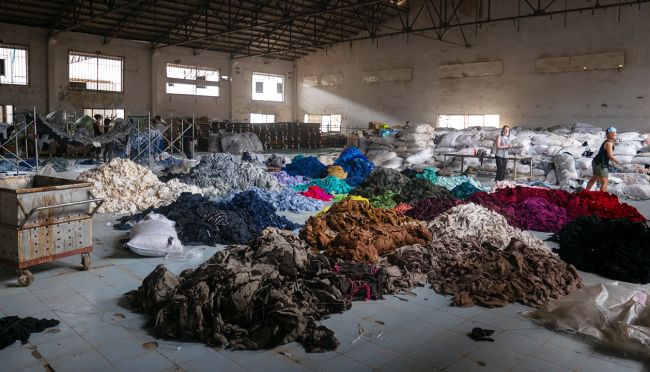
Can Fabric Waste Become Fashion’s Resource?
COVID-19 worsened the textile waste crisis. Now it's time for the fashion industry to address this spiraling problem, say Geoffrey Jones and Shelly Xu. Open for comment; 0 Comments.

- 16 Feb 2021
- Working Paper Summaries
Bollywood, Skin Color, and Sexism: The Role of the Film Industry in Emboldening and Contesting Stereotypes in India after Independence
Analysis of interviews with Bollywood producers and actors shows the extent of biases in the film industry during the decades after India’s independence in 1947. Gender stereotyping has remained a noteworthy feature of films, and bias towards light skin has only intensified.

- 02 Jun 2020
- Research & Ideas
Coronavirus Careers: Cloud Kitchens Are Now Serving
Cloud kitchens are restaurants built around food delivery rather than sit-down service, and they are increasing in popularity as COVID-19 disrupts the industry, write Lena Ye and Geoffrey Jones. Open for comment; 0 Comments.

- 19 Nov 2019
- Cold Call Podcast
Lessons from IBM in Nazi Germany
Geoffrey Jones discusses his case study, "Thomas J. Watson, IBM and Nazi Germany," exploring the options and responsibilities of multinationals with investments in politically reprehensible regimes. Open for comment; 0 Comments.

- 14 Nov 2019
- Book
Lifting the Lid on Turkey's Hidden Business History
The business history of modern Turkey has been largely hidden from view, but a new book edited by Geoffrey Jones and Asli M. Colpan pulls back the covers. Open for comment; 0 Comments.
- 06 Nov 2019
- Working Paper Summaries
Why Does Business Invest in Education in Emerging Markets? Why Does It Matter?
Drawing on 110 interviews with business leaders as part of the Creating Emerging Markets project at Harvard Business School, this paper represents the first systematic attempt to identify and compare investment in education across emerging economies, specifically in Africa, Asia, Latin America, Turkey, and the Persian Gulf between the 1960s and the present day.

- 26 Aug 2019
- Research & Ideas
Lipstick Tips: How Influencers Are Making Over Beauty Marketing
Influencer marketing has quickly become the best way to reach beauty consumers, proving more effective than celebrity endorsements and company ads, according to research by Alessia Vettese. Open for comment; 0 Comments.
- 03 Jul 2019
- Cold Call Podcast
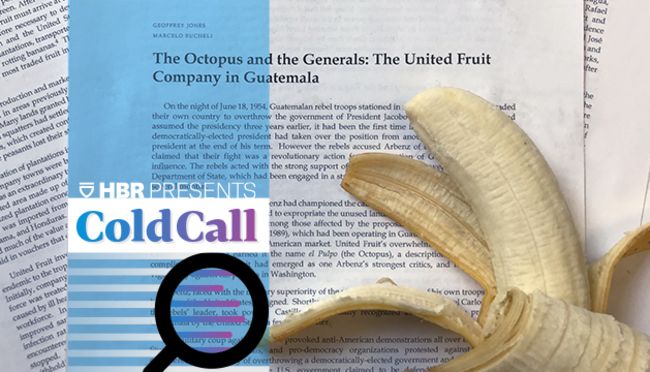
The Controversial History of United Fruit
Geoffrey Jones discusses the overthrow of President Jacobo Arbenz of Guatemala in 1954 in a US-backed coup supporting United Fruit Company and a key landmark in the history of globalization. Open for comment; 0 Comments.
- 11 Jun 2019
- Book
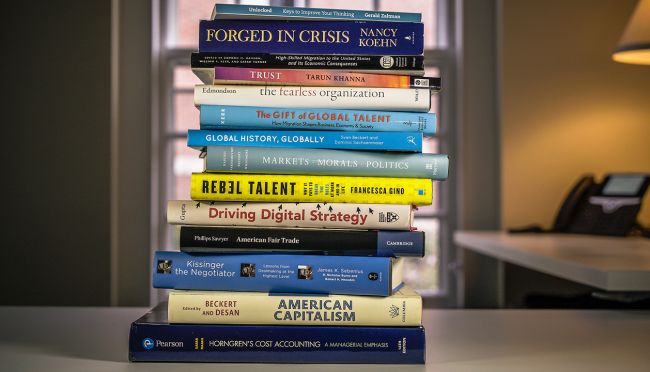
These Aren't Beach Books, but Managers Should Read Them Anyway
As you contemplate your summer reading, consider these recent books from Harvard Business School management scholars that can boost your career and improve on-the-ground management skills. Open for comment; 0 Comments.

- 15 May 2019
- Research Event
The Unconventional Capitalism That Shapes Business History
Geoffrey G. Jones reports on a business history conference studying the many shades of capitalism around the world and through time. Open for comment; 0 Comments.

- 14 Mar 2019
- Cold Call Podcast
How Helena Rubinstein Used Tall Tales to Turn Cosmetics into a Luxury Brand
Professor Geoff Jones examines the career of Helena Rubinstein, one of the trailblazing female entrepreneurs of the 20th century. Using guile, brilliant branding, and more than a few falsehoods, Rubinstein lifted cosmetics from an accessory item for prostitutes to a great luxury product during the Great Depression. Open for comment; 0 Comments.

- 04 Feb 2019
- Book
Green Businesses Are Incredibly Difficult to Make Profitable. Try It Anyway
Making a business successful is a challenge in itself, but making a green business profitable is an even harder journey. For society's sake, entrepreneurs must be prepared to make that journey, says Geoffrey Jones. Open for comment; 0 Comments.
- 07 Dec 2018
- Working Paper Summaries
Oral History and Writing the Business History of Emerging Markets
Oral history is a valuable resource to explore how businesses developed and functioned in Africa, Asia, and Latin America, regions with a growing share of global economic activity and the majority of the world’s population. While oral history is not uncritical, it provides openings for opinions, voices, and judgements on events on which there was often silence.
The Beauty Industry: Products for a Healthy Glow or a Compact for Harm?
Many cosmetics and skincare companies present an image of social consciousness and transformative potential, while profiting from insecurity and excluding broad swaths of people. Geoffrey Jones examines the unsightly reality of the beauty industry.